

Most buyers start with weight and thickness. Both are fixed by the design: thin enough to fit, light enough to hit the target. Strength is the number that decides whether the cloth survives the line.
On thin cloth, strength is also the first property to go. The yarn is finer, there is less material in the weave, and the margin narrows quickly.
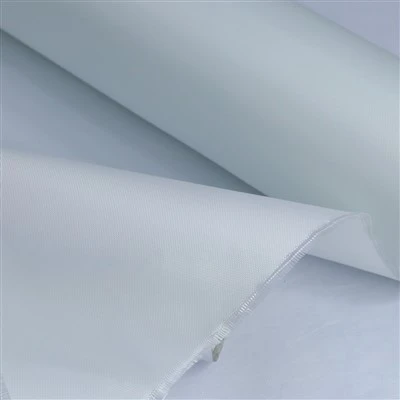
EW100 is a plain-weave glass cloth in that class. It weighs 105 g/m² (3.1 oz/yd²) and measures 0.11 mm (4.3 mil). The fabric ships white and uncoated. Warp and weft are both specified at 24 tex, or 24 grams per kilometer.
What the Tests Say
| Property | Tested | Specification |
|---|---|---|
| Yarn, warp / weft | 25 / 24 tex | 24 ± 1 tex |
| Weight | 105 g/m² (3.1 oz/yd²) | 105 ± 5 g/m² |
| Thickness | 0.11 mm (4.3 mil) | 0.10 ± 0.02 mm |
| Tensile, warp | 744 N/25 mm (170 lbf/in) | ≥ 350 N/25 mm (80 lbf/in) |
| Tensile, weft | 631 N/25 mm (144 lbf/in) | ≥ 300 N/25 mm (68.5 lbf/in) |
| Combustible matter | 0.09% | 0.08 ± 0.03% |
Weight came in at 105 g/m², right on nominal. Thickness measured 0.11 mm, inside the 0.08 to 0.12 mm window and slightly above the midpoint. Neither figure is hugging a tolerance limit.
Roll-to-roll drift is the expensive part. A fabric that varies forces the line to reset tension, resin pickup and press gap. Every reset costs a length of cloth.
The standard calls for ≥350 N/25 mm in the warp and ≥300 N/25 mm in the weft. Tested values are 744 and 631, slightly more than double in both directions.
That margin is not automatic on a thin cloth. Fine yarn puts less material in every square meter, and strength is the easiest property to trade away. These numbers did not come from weaving to the minimum.
Combustible matter came in at 0.09%. That figure measures the organic residue left on the fabric after burn-off, mostly sizing. Lower means cleaner. In impregnation and coating, less residue means fewer volatiles, fewer blisters and less bloom in the finished film.
Where It Is Used
The main use is thin laminates and composite parts. When a panel has to stay thin and the layer count high, the cloth has to be thin and even. It acts as the skeleton; the resin fills it. If the skeleton varies, the pressed thickness varies with it.
It is also used as a coating substrate. Customers take the greige cloth and run their own coating or laminating process. Because nothing is pre-applied, a fault downstream is easier to trace: it is either the fabric or the process, not a hidden layer between the two.
The third job is light reinforcement. Where a thick cloth will not fit and chopped-strand mat is too bulky or too random, a thin plain weave fills that gap.
Outside China, buyers usually call this material ultra-fine fiberglass cloth, or simply glass cloth. For a first specification, three figures are enough: 105 g/m², 0.11 mm, plain weave.
Certification and Ordering
EW100 has RoHS and halogen test reports, along with an MSDS; it ships as non-hazardous goods. The plant is certified to ISO 9001 and has been audited by SGS. Reports are available on request.
Minimum order is 1,000 m² (about 1,200 sq yd). Width and roll length are made to order. Rolls are packed in kraft paper and PE film, on pallets or in cartons.
Send the thickness, weight and quantity for your part, and we will check them against our test data. If you would rather test it first, we can send a sample length for you to run through your own process. That is the test that settles it.
About Ming Yang
Jiangxi Ming Yang Glass Fiber Co., Ltd. has made glass fiber products in Nankang, Ganzhou since 2001. The plant runs from glass yarn through weaving to composite finishing. It is certified to ISO 9001 and has been audited by SGS. Its range covers woven glass fabrics and aluminum foil laminates.