

In a ceramic composite tape, the glass cloth is a small part of the cost. When something fails, it is often the first part blamed.
A cracked ceramic layer, tape thickness out of tolerance, a break at the slitter. Trace any of them back far enough and the same layer appears: the base cloth.
Most plants in this business already stock 2116. It is thin, well documented, and works with ceramic silicone. It was designed for copper-clad laminate, though, and a coating line asks different questions.
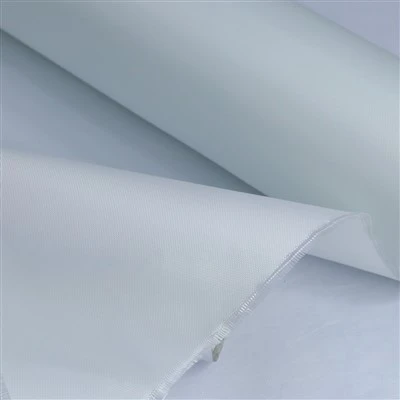
We weave both 2116 and EW100. Both weigh 105 g/m² and look much the same on a table. The differences are thickness, strength, and what is left on the surface of the cloth.

Measured Side by Side
| Property | 2116 electronic cloth | EW100 coating substrate |
|---|---|---|
| Weight | 105 g/m² | 105 g/m² |
| Thickness, measured | 0.09 mm | 0.11 mm |
| Thickness, standard | 0.10 ±0.012 mm | 0.10 ±0.02 mm |
| Warp density | 23.6 ends/cm | 23.5 ends/cm |
| Weft density | 23 picks/cm | 18.5 picks/cm |
| Tensile, warp | 308 N/25 mm (spec ≥250) | 744 N/25 mm (spec ≥350) |
| Tensile, weft | 246 N/25 mm (spec ≥200) | 631 N/25 mm (spec ≥300) |
| Combustible matter | 0.10% | 0.09% |
Start with thickness. 2116 measured 0.09 mm against a 0.10 ±0.012 mm standard. EW100 measured 0.11 mm against 0.10 ±0.02 mm. The gap is 0.02 mm, which is not something a hand can feel.
On a coating line, the base cloth's variation adds to the finished tape's total thickness. 2116 holds a tighter tolerance because laminate pressing needs it. EW100 gives up some of that, which is enough for coating. It also starts 0.02 mm thicker, so the coating does not have to be pressed to its limit to reach the target.
The weave explains part of it. Warp density is almost identical: 23.6 ends/cm for 2116, 23.5 for EW100. Weft density is not: 23 picks/cm against 18.5. At the same weight, the cloth with fewer weft yarns ends up at 0.11 mm.
Strength needs care, because the two cloths are accepted against different standards. 2116 calls for ≥250 N/25 mm in the warp and ≥200 in the weft; the tested values are 308 and 246. EW100 calls for ≥350 and ≥300; tested values are 744 and 631.
That does not make one stronger in absolute terms. What the numbers show is margin. A coating cloth gets slit narrow and wound under tension. Extra margin on a 25 mm strip turns into fewer breaks on the line.
The gap comes from yarn, weave and the acceptance standard together.
For electronic cloth, the real contest is not strip tensile strength. After pressing, resin surrounds the cloth, and the board is judged on thickness uniformity, dielectric constant and dimensional stability. 2116 is made to those requirements.
Combustible matter is 0.10% for 2116 and 0.09% for EW100. The figure measures organic residue on the cloth, mostly sizing. Both are low.
A clean surface releases fewer volatiles during cure, which means fewer blisters and pinholes in the coating.
One item does not appear in the table. Electronic cloth is desized and treated with a coupling agent chosen for epoxy, so it bonds to laminate resin. Ceramic silicone is a different system. No data sheet can settle that match. A sample run on your own line answers it better than a comparison table.
Where EW100 Goes
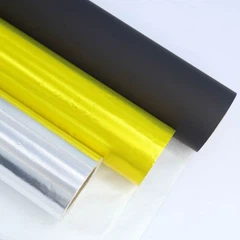
EW100 is mostly sold as a base cloth for coaters. Coated with ceramic silicone, it becomes a fire barrier tape used between battery modules, in storage cabinets and around cable harnesses.
The cloth's job is structural. Once fired, the ceramic layer is hard and brittle. Vibration and thermal cycling crack it. The glass network holds the ceramic in place, so a crack does not turn into a section that falls away.
Some customers use it in thin laminates and light reinforcement. The greige cloth ships to them, and coating or laminating stays in their hands.
How to Choose
If the cloth has to carry circuits, go through a press, or hold a low dielectric constant, 2116 and 7628 are the grades to use.
If it has to take ceramic coating, slitting and winding, look at EW100.
We weave both. A project often needs both grades, and the specifications can be checked together.
When the choice is still open, ask for a roll of each and run both on the line.
Certification and Ordering
EW100 has RoHS and halogen test reports, and an MSDS for non-hazardous transport. The plant holds ISO 9001 and SGS certification. Reports are available on request.
Minimum order is 1,000 m². Width, roll length and weight can be set per order. Rolls ship in kraft paper and PE film, on pallets or in cartons.
For a ceramic tape or fire barrier program, send the weight, thickness, width and volume. We will check the figures first, and we can send a sample for a trial run on your coating line before you commit to a batch.