

Pull the cover off an EV battery pack and the first things you see are modules, busbars and cable harnesses. The BMS board sits alongside the modules, carrying sampling signals and relay control.
Cut that board's copper-clad laminate in half and the stack is simple: copper foil, resin-soaked glass cloth, copper foil, pressed into a sandwich.
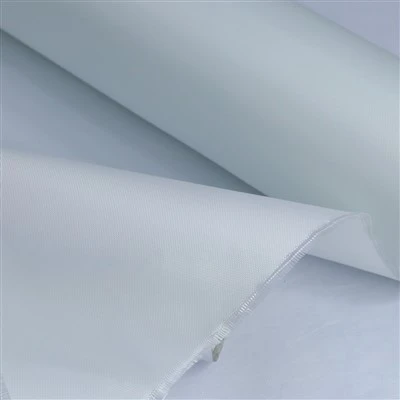
The cloth is white with a fine weave, 0.18 mm thick, about the same as two sheets of printer paper. The industry calls it electronic cloth. In EV boards, the grade used in the largest volume is 7628.

The Cloth Is the Skeleton
A copper-clad laminate has two layers of electrodeposited copper foil with epoxy-impregnated glass cloth between them. The stack goes into a press at about 200°C and cures. The foil is later etched into circuits. Cloth and resin stay where they are, forming the insulation and the structural layer.
Resin alone is brittle. It expands when heated and deforms under load. The fabric holds it in place and keeps thickness, flatness and dimensional stability under control.
That is why a board's ability to carry heavy copper, run at high Tg or hold high voltage is decided at the cloth stage.
What an EV Board Adds
The difference between an automotive board and a consumer board is margin. A failed consumer board gets replaced. A failed board in a car can stop the vehicle. Automotive programs push the laminate requirements up a notch.
The first number is Tg, the glass transition temperature. Below Tg, epoxy stays hard and stable. Above it, the resin softens and its expansion in the Z axis climbs sharply.
One high-Tg laminate datasheet puts the two figures side by side: 41 ppm/°C below Tg and 208 ppm/°C above it. Copper expands at 17 ppm/°C. Heat the board and the resin grows in thickness while the cloth and copper grow far less. The copper lining a via gets pulled from both ends until it cracks. Delamination and blowholes usually start here.
IPC-4101 sets the high-Tg line at 170°C. Automotive electronics commonly see 125°C at the top of their operating range, and higher near the powertrain. Allow 20 to 30°C between working temperature and Tg, and 170°C is where an automotive board starts.
CTI comes next. The comparative tracking index measures how much voltage it takes to form a conductive carbon path across a dirty, damp surface. Dust and moisture sit on the board; voltage is applied between two electrodes; the test records the point where tracking begins. A higher number means less tracking.
The industry grades parts at 175, 250, 400 and 600 V. A body ECU or domain controller usually sits in the 175 V class. BMS, OBC and charging piles move to 400 or 600 V. With 800 V platforms becoming common, that item carries more weight than it did five years ago.
CTI does not depend on resin alone. Fabric cleanliness, resin wet-out and adhesion all shape the surface leakage path. Fuzz, stains or dry spots after impregnation make a high CTI hard to reach.
Copper weight is the third check. BMS boards commonly run 2 to 3 oz, OBC and charging piles 2 to 4 oz. One ounce is 35 µm, so 4 oz is 140 µm.
Heavier copper etches more slowly and needs more resin during pressing, which narrows the flow window. A small change in cloth thickness or impregnation speed can produce a dry spot or an out-of-tolerance panel. Heavy-copper boards are far more sensitive to thickness tolerance and impregnation than ordinary boards.
Flame rating is the fourth. Automotive FR-4 usually has to meet UL94 V-0: self-extinguishing within 10 seconds of removal from the flame, with no burning drips.
Halogenated systems use brominated flame retardants. They are cheap and well understood. Halogen-free systems use phosphorus and nitrogen chemistry, with less smoke and corrosive gas in a fire. The common halogen-free limit is 900 ppm each for bromine and chlorine, and 1,500 ppm combined.
At BMS and charging positions, halogen-free has moved from a bonus to a customer requirement. European automakers moved first. Chinese battery makers are following.
Why 7628 Carries the Volume
7628 is a plain-weave E-glass cloth. Our standard is 200 g/m² (5.9 oz/yd²), 0.18 mm (7.1 mil), with 17 by 13 ends per centimetre.
It goes into ordinary FR-4. A 1.6 mm double-sided board is commonly built from eight sheets of 7628 prepreg. Thinner boards use fewer sheets, thicker boards more. The grade does not change; the layup does.
Thin boards and the inner layers of multilayer boards cannot take 7628, so they move to 2116. At 105 g/m² and 0.10 mm, 2116 is about half the thickness. Stacking thin layers is how the total height stays under control.
Thinner is not automatically better. Board thickness, copper weight, layer count and impedance set the layup before the cloth is chosen. 7628 handles ordinary and heavy boards, 2116 handles thin inner layers. Each does its own job.
Where Each Board Uses Which Cloth
| Position | Board thickness | Copper | Tg / CTI | Cloth |
|---|---|---|---|---|
| Body ECU, domain controller | 1.6 mm | 1 oz | ≥150°C / 175 V class | 7628 |
| BMS | 1.0-2.0 mm | 2-3 oz | ≥170°C / 400 V class | 7628, 2116 in thin sections |
| OBC, DC-DC | 1.6-2.0 mm | 2-4 oz | ≥170°C / 600 V class | 7628 plus 2116 |
| Charging pile | 1.6-3.0 mm | 2-4 oz | ≥170°C / 600 V class | 7628 plus 2116 |
These are common ranges, not rules. The laminate supplier and the OEM specification decide each program. Traction inverter power stages do not use FR-4 at all. They use insulated metal substrates or DBC ceramic boards, with copper up to 10 oz and beyond. FR-4 conducts heat at about 0.25 W/m·K, which cannot move the heat density a power stage produces.
Our 7628
We weave 7628 to 200 g/m², 0.18 mm, 17 by 13 ends per centimetre, plain weave. It ships as greige cloth, without adhesive or coating. Widths are 1.05 m and 1.27 m; roll lengths are 50 m, 100 m and 2,000 m. Minimum order is 1,000 m².
Electronic cloth separates from industrial cloth after weaving. Greige cloth leaves the loom carrying sizing, which is burned off in a high-temperature desizing step. It then passes through a silane coupling agent, one end bonding to glass and the other to epoxy. Even pickup decides how the laminate survives solder float and thermal shock. A final low-tension dry sets width and controls warp and weft shrinkage.
None of that shows on the roll. It shows in the pressed board. Fuzz or broken yarn becomes white spots and patches. A thickness that wanders produces dry spots and voids. Poor coupling shows up as delamination and blowholes. Automotive programs leave little room for any of it.
We also weave 2116 at 105 g/m² and 0.10 mm, with full outgoing inspection records. When a thin inner layer needs it, the two grades can be checked together.
Certification and Ordering
The plant holds ISO 9001 and SGS certification. Product data and samples are available on request.
For an automotive, heavy-copper or thin-board program, send the board thickness, copper weight, Tg and CTI requirements, and an estimated volume. We will check the layup against our data first. If you want to test before committing, we can send a sample length to run through your own press. The press settles it faster than a datasheet.